Multilingual Service Provider Resource Collection
As a multilingual service provider (MSP)—an audiologist, speech-language pathologist (SLP), audiology assistant, or speech-language pathology assistant (SLPA) who uses more than one language during professional and/or clinical service delivery—you represent a growing constituency within the professions.
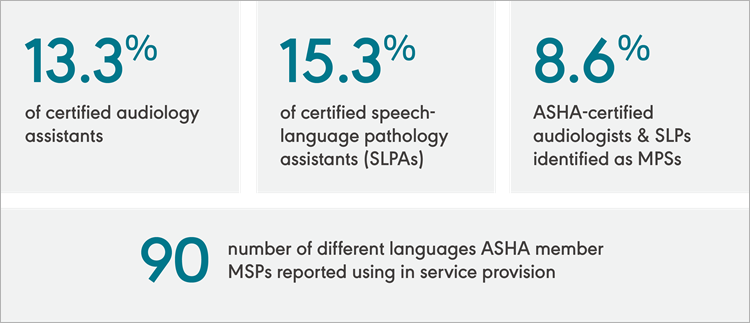
To learn more, see ASHA's survey reports and ASHA's member data reports.
To support your career as an MSP, ASHA provides:



Why Self-Identify as an MSP

As an MSP, you are in increased demand, and self-identifying can be a productive way to find your professional community and support multilingual patients or students. It also allows ASHA to provide resources to support you as an MSP in your clinical work.
ASHA encourages MSPs to self-identify to highlight your ability to use multiple languages during audiology or speech-language pathology service delivery. If you haven’t yet done so, take a moment to self-identify as an MSP in your ASHA member profile.
How to Use ASHA's Member Tools
Use the step-by-step guides below to help you connect with opportunities and grow your career as an MSP.
You can self-identify as an MSP in your ASHA Member Profile using these simple steps:
- Log into your ASHA account.
- Go to My Account.
- Go to Manage Your Information.
- Select Multilingual Service Provider.
- In the Languages box, select the pencil to edit.
- Enter your language(s), and then select Add Language and Save.
You may be listed on ASHA ProFind so future clients can find you when seeking a language-matched MSP. Here’s how to do that:
- Go to the My Account page.
- Check your enrollment by going to the section titled ASHA ProFind.
- Select Manage Your ProFind Preferences.
If you’re an employer looking to recruit MSPs, the ASHA Career Portal makes it easy to connect with professionals who have language skills to meet the needs of the communities you serve. Follow these steps to post a job that seeks multilingual providers.
- Visit the ASHA Career Portal.
- Select “Post a Job,” and choose your preferred posting package.
- Follow the prompts to either
- create an employer account or
- log in to an existing account.
- Complete the Job Posting Form.
- Publish the job. Your post will now be searchable by candidates who are specifically seeking multilingual opportunities.
Tips for Employers
- Clearly state that you are seeking multilingual providers.
- Use phrases such as these:
- “We encourage applications from bilingual and multilingual providers.”
- “Language proficiency in [insert specific language] is preferred.”
- “Language proficiency in [insert specific language] is required.”
- Include relevant keywords in your job description—for example:
- bilingual
- multilingual
- Name the specific languages you are seeking—for example:
- Spanish
- Haitian Creole
- ASL
If you are an MSP seeking employment, follow these steps to use the ASHA Career Portal.
- Visit the ASHA Career Portal.
- Use the search bar to enter keywords that will help you find jobs that are specifically seeking providers who can use multiple languages.
- You can search on keywords like bilingual or
- You can also search by specific languages—such as French, Mandarin, or ASL.
If you have questions or need support, contact careerportal@asha.org.
If you’re an MSP looking to join an ASHA Community to connect with multilingual professionals, follow the steps below (Note: You must have a “My ASHA” account):
- Visit the ASHA Community homepage or go to the ASHA website and type “ASHA Community” into the search bar—enter the same credentials that you use to log into the ASHA website.
- From the top-left menu, select Communities.
- Then select Join a Community.
- The default filters will take you to your current communities. You can filter your options by community type, communities that are accessible to you (options include view only, joined, can join), or alphabetically.
- From the listing of communities that you can view, belong to, and/or join, find Culture, Language, and Identity.
- Select Join to confirm your email address and to select how you would like to receive messages from this Discussion (e.g., as they come in, daily, weekly digest, etc.).
- To confirm your selection, return to the top-left menu, and select My Communities to see a listing of your current communities—which should now include Culture, Language, and Identity.
Help and Additional Resources
Want to learn more about getting started in ASHA Communities, find helpful resources, explore FAQs, or find information for volunteers? Visit the Community Help webpage,or select “Help” from the top-left menu.

ASHA offers a wealth of resources to support your work as an MSP. You can also network with other MSPs to enhance your practice.
Practice Portal Pages for MSPs
In the ASHA Practice Portal, MSPs can find information on various clinical and professional topics. You’ll also find handouts and tools to facilitate clinical decision making and increase practice efficiency. Here are some resources specific to multilingual service delivery that can help you provide language-matched and cross-linguistic services to your multilingual clients.
- The Multilingual Service Provider (MSP) Practice Portal page focuses on the knowledge and skills needed for language-matched multilingual care.
- The Multilingual Service Delivery in Audiology and Speech-Language Pathology Practice Portal page focuses on clinical practice with (a) clients who use a language different from that of the provider or (b) clients who use multiple languages.
- The Collaborating With Interpreters, Transliterators, and Translators Practice Portal page focuses on the roles and factors that audiologists, SLPs, and assistants consider when working with interpreters, transliterators, and translators.
Language-Specific Resources for MSPs
Do you need language-specific resources to support your professional and clinical needs? ASHA has resources for the following services:
- permission for translating ASHA content into your clients’ languages
- providing translation support while you prepare your manuscript for publication in the ASHA journals
- cultural, linguistic, and developmental information about languages used in the United States
Below you will find a variety of language-specific resources to support you as an MSP including these and other tools:
- translation permission
- phonemic inventories data
- and other tools
You can request permission to translate ASHA content in order to support linguistically appropriate care by sharing materials that are translated into the language of your clients and communities.
Frequently requested resources include journal articles, consumer information, assessment tools, infographics, and more.
Use Case Examples
Here are examples in which requesters filled out ASHA’s translation permission request form and subsequently distributed ASHA content in a wide-reaching, successful way. In doing so, they made important ASHA resources available in a variety of languages—thus making effective communication accessible and achievable for all.
- Academic research translation: A graduate student at a university in Türkiye conducting dissertation research on voice disorders needed to translate the Voice Handicap Index (VHI) for their study. Because the VHI was published in a peer-reviewed ASHA journal, they used ASHA’s form to request permission to create a translated version in Turkish to use with their research participants.
- Pediatric feeding resources for rural communities: An SLP working at a small rural hospital in the United States noticed that the ASHA Developmental Milestones: Feeding and Swallowing are available in English and Spanish. However, their community has a large population of people who speak Russian. This SLP collaborated with a translator—who will translate these milestones into Russian. The SLP’s first step in doing this was to fill out ASHA’s form requesting permission to translate the developmental milestone charts and parent tips into Russian.
- Audiology patient education materials: An audiologist wanted to share a helpful tinnitus infographic with their patients, but the existing patient education materials were available only in English and Spanish. Because this audiology practice serves patients who speak Arabic, the audiologist submitted a request to translate the infographic—making this important hearing health information accessible to more patients.
The ASHA Manuscript Editing Services, offered in partnership with Editage, provides MSPs with expert editing support to ensure that your research meets international publication standards. These services include
- grammar and language refinement,
- journal-specific formatting, and
- feedback on manuscript organization and clarity.
Using ASHA Manuscript Editing Services empowers professionals to effectively share their work with global audiences.
Use Case Example
Preparing international research for publication: A clinician collaborated with a researcher to evaluate therapy services in Japan. The researcher's primary language is Japanese, and they wanted to publish their findings in an English-language journal. They used the manuscript editing service to ensure that their article met English-language publication guidelines.
ASHA’s Phonemic Inventories and Cultural and Linguistic Information Across Languages webpage provides information on (a) speech sound systems of various languages and (b) general phonological or language patterns that may impact the use of English. This resource offers MSPs:
- access to detailed phonemic data and cultural insights for a wide range of languages
- support for assessment by helping distinguish between features of communication differences and communication disorders
- support for intervention by helping you identify similar sounds in different languages and the rules for sound combinations (phonotactics) in those languages
Use Case Example
Evaluating sound identification in different languages: An SLP wanted to identify whether a student was showing signs of an articulation disorder in their languages — Tagalog and English. The SLP knew that exposure to both languages could influence this student’s speech sound production. They used the phonemic inventories for Tagalog and English to (a) identify similarities and differences between the sound systems, and (b) determine whether the student makes unexpected errors in both languages.
Multilingual Service Delivery With Spanish-English Speaking Children and Families is the first ASHA Journals Special Collection that focuses on a specific language community in the United States. It offers a curated set of research articles, clinical resources, and practical tools to support audiologists and speech-language pathologists working with multilingual (Spanish–English) children and families. This collection helps you deliver care by offering guidance on assessment, intervention, caregiver training, and collaboration with interpreters—all tailored to Spanish–English speaking communities.
If you are an MSP looking for a community and seeking language-specific resources, consider checking out the Multicultural Constituency Groups (MCCGs). MCCGs are independent professional organizations that acknowledge the influence of languages, dialects, accents, and lived experience on
- service delivery,
- advocacy, and
- professional development.
These groups offer networking opportunities, mentorship, and resources that enhance the quality of and access to care.
Use Case Example
Professional collaboration with other MSPs: A Vietnamese-speaking audiologist has had a frustrating day of being asked to interpret for other clinicians because they do not speak Vietnamese. The audiologist wanted to connect with other professionals in a similar situation and perhaps come up with ideas to set some limits. The audiologist joined the Asian Pacific Islander Speech-Language-Hearing Caucus and connected with other professionals in similar situations to come up with ideas.
Bill of Language Rights
ASHA developed the Bill of Language Rights as a critical step toward changing practices to ensure language justice.

ASHA provides tools, training, and opportunities for your professional growth and connection. From elevating your career to providing networking opportunities, ASHA is here to support your practice as an MSP.
Career
From recruitment materials to continuing education resources to tools that help you find jobs, ASHA resources help CSD professionals in so many ways:
- support your career development
- prepare you for your next position
- refine and expand your expertise
- cultivate your leadership skills and engagement
- identify funding opportunities for your next project—one that might focus on improving access to language-matched speech-language and hearing services or clinical training
The ASHA Job Seeker Toolkit supports audiologists and SLPs in:
- identifying positions for MSPs,
- preparing application materials to highlight MSPs’ unique and valuable skillset, and
- advancing careers in settings to enhance multilingual service delivery.
Use the keywords “bilingual and/or multilingual” on the Career Portal to identify positions that value your language abilities, cultural knowledge, and clinical expertise. Using this database, you can locate roles where you can deliver linguistically appropriate care and serve communities that need your skills.
ASHA’s Grant program supports MSPs by funding innovative projects that enhance and expand services and supports. With access to previously funded projects and guidance on applying for the grant, MSPs can develop activities and research projects to improve communication and educational outcomes for clients and students from various linguistic backgrounds.
The Leadership Development Program equips MSPs with the skills and support needed to grow as leaders in the professions of audiology and speech-language pathology. The program may help participants advocate for global attention to multilingual service delivery and drive positive change within communities and professional settings.
ASHA provides a range of offerings for Continuing Education (CE) credit that targets learning opportunities for MSPs. These resources help audiologists and SLPs
- enhance their clinical skills,
- provide access to personalized care and improved outcomes, and
- stay current on best practices and materials for serving multilingual populations.
You can choose the format that best fits your busy schedule, including options like these:
- live and on-demand webinars
- self-studies on articles from ASHA Journals
- micro courses
ASHA Store Search
- Select “ASHA Store” at the top of the ASHA website
- Enter “bilingual” or “multilingual” in the search bar (for best results, do separate searches on each word).
- Select “CE Courses” in the “Category” search option.
- Select your preferred type of resource in the “Course Format” search option.
ASHA Learning Pass Search
- You can search the catalog of the ASHA Learning Pass without being a Learning Pass member.
- Go to the ASHA Learning Pass landing page
- Select “Browse Course Catalog” on the ASHA Learning Pass landing page.
- Enter “bilingual” or “multilingual” in the search bar (for best results, do separate searches on each word).
- Select your preferred type of resource in the “Course Format” search option.
ASHA Learning Pass Curated Collections
We’ve done the work for you! Access courses on topics related to multilingual service provision.
Some CE credits that are offered through the ASHA store and available through the ASHA Learning Pass include the following:
On-demand webinars
- Translanguaging for Pediatric SLPs: Service Delivery With Multilingual Children
- Speech Audiometry for Linguistically Diverse Populations
Journal article self-studys
- A Review of Recommendations for Families Raising Multilingual Children With Autism and Examining Types of Support Received by Multicultural Individuals Who Stutter
- Clinical Considerations for Working With Multicultural Populations in Schools and in the Community
Micro courses
Courses
- AAC for Multilingual Learners (PD103008) – In this ASHA Professional Developmemt course, three SLPs share their perspectives on (a) working with multilingual students and (b) overcoming challenges and barriers to equitable and effective augmentative and alternative communication (AAC) interventions. This course is also available on ASHA Stream.
In addition to finding CE courses, you can search for informational brochures and resources in both Spanish and English in the ASHA Store. Enter “bilingual” in the search bar and select “Consumer Education” in the “Category” search option. Available resources include search results like these:
- Bilingual Diagram of the Ear (on one side is a detailed diagram of the outer, middle, and inner ear—flip over for an illustration of a hearing aid and its components and examples of current devices. Both sides are labelled in English and Spanish)
- Hablemos Patient Education Handouts for Children en Español (printable and customizable client education handouts)
- Help Your Child Succeed in School, 2nd Edition (brochure takes parents and caregivers through the process of assessment for additional educational services)
Networking
Creating and maintaining active connections helps you deliver more effective services to the communities you serve. ASHA provides mentor programs, online communities, and recruitment materials that help you build your network and foster connections as an MSP.
Student to Empowered Professional (S.T.E.P.)
Student to Empowered Professional (S.T.E.P.) is an online mentoring program that connects CSD students with practicing professionals. All CSD students are welcome to participate. Multilingual students have the opportunity to search for mentors who are language-matched. More than 500 MSPs have participated in the S.T.E.P. online mentoring program as students. S.T.E.P. also offers a seminar speaker series, as well as an online community.
Audiology Mentor Program (AMP)
Audiology Mentor Program (AMP) is a virtual mentoring program that connects either AuD students to practicing audiologists or practicing audiologists to one another. When creating your mentee or mentor profile, indicate the languages that you use—this will help multilingual students and/or service providers easily connect with you.
ASHA Community on Culture, Language, and Identity
ASHA offers a community for CSD professionals committed to provide services that align with the unique histories, values, and circumstances of individuals, families, and communities. Sample topics may include aspects of person- and family-centered care, such as multilingual and multi-dialectal assessment and treatment, second-language or second-dialect acquisition, or working with cultural mediators, translators, and interpreters. Connect, ideate, and discuss with engaged ASHA members, including multilingual service providers.
Recruitment Materials
To help introduce students to a rewarding career in CSD, ASHA offers resources that are free to download or order. These tools also highlight why multilingualism matters!

As an MSP, your multilingual abilities and clinical expertise are valuable elements of your work. Multilingual service provision may require more time—and a specialized level of knowledge and training. Employers may not think to consider these skills and expertise when calculating salary and determining workload.
ASHA offers resources to help you advocate for fair compensation and an accurate calculation of your workload or productivity. Here are some suggestions and strategies for talking about the value of your multilingual skills.
As you become familiar with your organization, you can find ways to advocate for compensation and an accurate calculation of your workload. Explore these questions:
- How does your organization calculate your salary and workload or productivity?
- Does your employer offer supplements or pay grade increases for additional education?
- What is the turnover or vacancy rate for clinicians?
- What is the relationship between (a) high workload or productivity requirements and (b) professional burnout?
- Are there additional initiatives that require your time—especially related to your skills as an MSP?
Capture the activities required to effectively manage your workload. Think about any additional activities beyond documentation—for example, team meetings, training, and care coordination activities.
The ASHA Workload Calculator is a resource that MSPs working in schools can use to calculate time spent on different tasks. There are lines and blank fields where you can add tasks unique to multilingual service provision. Calculate whether multilingual service provision requires more time than monolingual service provision—and document that difference.
Gather information about how your multilingual services promote effective outcomes.
For health care providers, this can include how multilingual services help
- prevent hospitalizations,
- shorten length of stay,
- reduce re-admissions,
- impact patient-reported outcomes and satisfaction ratings, and
- support compliance.
For school providers, this can include how multilingual services help
- improve student progress toward individualized education program (IEP) goals,
- increase caregiver engagement in therapy goals,
- reduce risk of parent complaints or hearing of determination meetings (HODs), and
- improve interprofessional collaboration with other school professionals.
See also a list of evidence-based studies supporting the positive impact of multilingual service provision [PDF].
See how multilingual speech-language pathologists improve outcomes for multilingual clients in The Value of Multilingual Speech-Language Pathologists.
Use your research to lay out a case using language and terms that mirror the mission and policies of your workplace. Consider using a framework in which you do the following tasks:
- State the issue (e.g., “Current workload calculations do not include extra time required for providing multilingual service provision.”)
- Assess what past efforts worked and didn’t work.
- Determine when the best time is to address this depending on budget cycles and funding sources for your employer.
- Connect with your state speech-language-hearing association to determine if a statewide initiative is already under way or would be appropriate to initiate.
- Gather data from other districts (see ASHA’s statewide salary supplement advocacy and local district salary supplement pages).
- Identify current stakeholders and determine their positions.
- Garner support from those impacted by the issue (including union support, if appropriate and parents of children receiving services).
- State the requested action and the underlying rationale.
- Describe the positive impact of the action— based on your research.
- Suggest next steps for your employer.
When communicating with your manager think about the following strategies:
- Consider the most optimal context for this important conversation: Which format, place, and time will most likely allow the manager to focus on the discussion?
- Send information and supporting documentation ahead of the meeting for their review, if appropriate.
- Use your talking points (see previous section above) to present your case in a positive, collaborative manner—with an emphasis on responding to the concern underlying the policy.
- Encourage your manager to take time to consider the information you’ve provided; return to the discussion later, if needed.
When direct conversations don’t lead to change, it may be time to get others involved.
- Talk with a director or other leaders at the organization to get guidance on the next steps for escalating your concerns in your facility. Here are some examples:
- Contact your organization’s Human Resources department.
- Contact your organization’s compliance officer.
- Connect with an outside ombudsman.
- Reach out to your State Education Advocacy Leader (SEAL). SEALs are appointed by state speech-language-hearing associations to advocate on education issues for audiologists and speech-language pathologists.