Multi-Tiered Systems of Support (MTSS)
The term multi-tiered systems of support (MTSS) describes a broad educational framework that provides students with increasingly intensive levels of support to meet their academic and non-academic (behavioral, social and emotional) strengths and areas of need.
This system-wide framework focuses on improving core (Tier 1) instruction to prevent learning and behavioral difficulties before they arise. Students who may benefit from targeted or individualized support have access to Tier 2 and Tier 3 interventions that rely on continuous collaboration within the school system. Data-driven decision making and evidence-based practice ensure all students’ progress.
Response to intervention (RTI) is one element of a multi-tiered system of support (MTSS) for providing services to targeted learners at increasing levels of intensity. RTI is related to, but distinct from, MTSS. RTI focuses on identifying disabilities in a valid manner by tracking how students respond to interventions, whereas MTSS is system-wide framework focused on proactively supporting student needs.
On this page:
Features of the Tiers
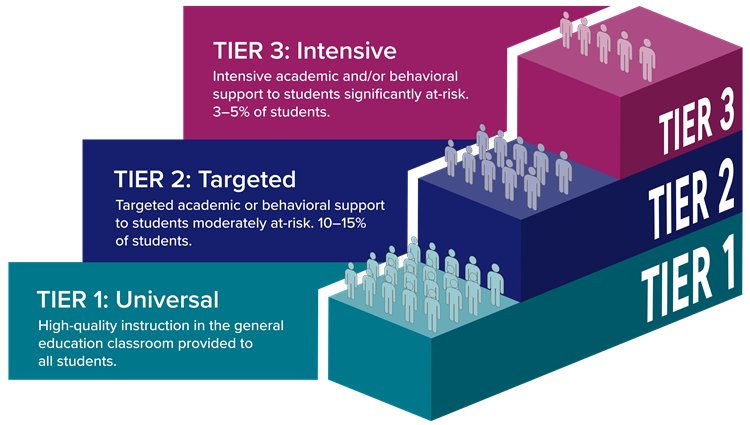
This figure represents a classroom of approximately 20 students.
Tier 1 - Universal Support
- Tier 1 is proactive and preventative.
- It includes research-based core instruction and supports aligning with grade-level standards for all students.
- Teachers use differentiated instruction for all students to access the curriculum.
- Most students benefit from Tier 1 programming alone.
Tier 2 - Targeted Interventions
- Tier 2 programming is delivered wiht greater intensity than Tier 1 programming.
- It consists of targeted small-group interventions for students who need additional support beyond Tier 1.
- In Tier 2 programming, specific teams select or design evidence-based interventions and supports that meet student needs and help achieve desired outcomes.
- Interventions at this tier allow increased opportunities for practice and corrective feedback.
Tier 3 - Intensive Interventions
- Interventions at the Tier 3 level are increasingly more intense than those at the Tier 2 level.
- Tier 3 interventions involve individually tailored/targeted support.
- Tier 3 is designed specifically for students with significant and persistent academic, social, emotional, or behavioral needs—including diagnosed disabilities.
- Instruction and support at the Tier 3 level is individualized and data driven.
Why SLPs Should be Involved in MTSS
Speech-language pathologists (SLPs) bring specialized expertise in language, literacy and evidence-based assessment that directly informs effective tiered instruction and intervention within MTSS. When SLPs are involved in MTSS, it allows them to:
- Collaborate with educators and related professionals (e.g. classroom teachers, special education teachers, school psychologists, counselors, curriculum coaches, school administrators)
- Improve the quality of instructional practices—with the aim of preventing students from requiring more specialized services.
- Proactively support students
- Include students who need support but may not qualify for an individualized education program (IEP).
- Meet students’ needs without relying solely on special education services.
- Meet the needs of students with disabilities
- Integrate speech-language services into the general education curriculum.
- Provide relevant data to inform decision making
- Accurately identify students with disabilities.
- Inform and support appropriate eligibility decisions.
Reference: Sylvan, L. (2026). Multi-tiered systems of support: Implementation tools for speech-language pathologists in education from Plural Publishing.
Key Benefits of MTSS
When implemented with fidelity, MTSS can enhance the SLP’s role and student outcomes as:
- The framework enhances opportunities for interprofessional practice and collaboration.
- Students may experience improved generalization and dissemination of strategies.
- This approach builds a stronger sense of community and purpose within the school.
- The negative effects associated with labeling students is potentially reduced when students' needs are met outside of special education.
- Staff are better able to meet student needs without special education paperwork, potentially reducing workload.
Reference: Sylvan, L. (2026). Multi-tiered systems of support: Implementation tools for speech-language pathologists in education from Plural Publishing.
See how students' communication and literacy skills improve with support from the school-based SLP in The Value of the Speech-Language Pathologist (SLP) in Schools: Prevention and Response to Intervention.
Learn More
- Funding for MTSS Implementation
- Implementing MTSS: Case Studies
- MTSS in States
- MTSS: What’s True and What’s False?
- Resources for Implementation of MTSS
- What Federal Policies Say About MTSS
- What Research Says About MTSS
Acknowledgements: ASHA extends appreciation to the member volunteers who contributed to the 2026 revision of this resource: Lesley Sylvan who served as content lead, Jan Alejado, Kresta Atkin, Jill Barton, Heather Eisenberg, Robin Gaffney, Melanie Harper, John Heilman, Tiffany Hines, Meaghan McKenna, Sarah Moon, Kaitlin Oliveri and Laurel White.