Funding Outcomes of ARM Network Grant Writing Program Participants
Four of ASHA's eleven ARM Network Programs focus on grant writing: CPRI, DISTAnce, Pathways, and LfS. ASHA currently supports over 65 individuals annually through these four grant-writing programs. To assess the impact of these programs, ASHA collects data on key scholarly accomplishments of program participants, including funding submissions and awards. ASHA measures short and long-term participant outcomes by surveying participants at 3 years and at 6 years following their participation. Responses reflect activities accomplished at any point during those respective time frames. Below are data collected over the past three years and, therefore, the short-term and long-term outcomes reflect the accomplishments of different cohorts.
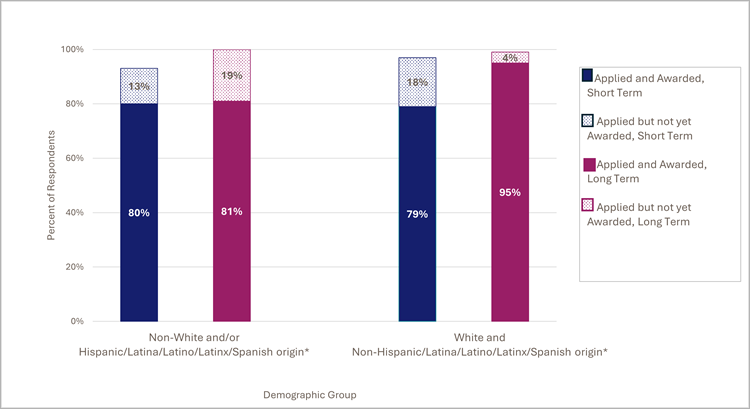
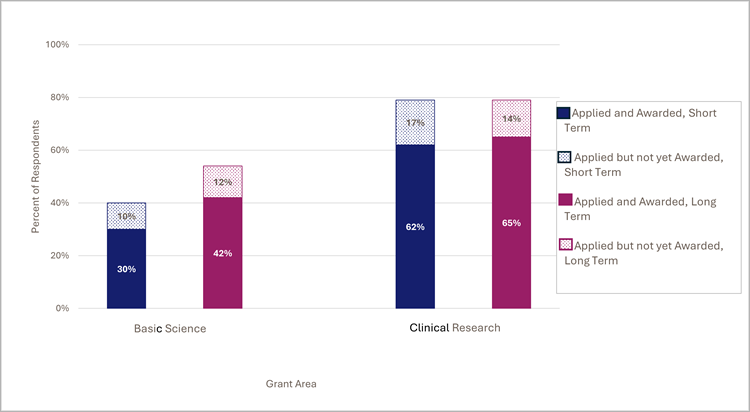
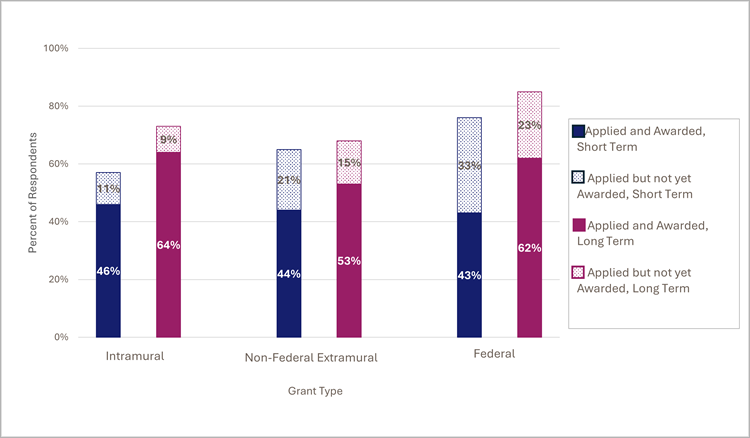
The following 3 graphs illustrate the short-term funding outcomes of the 2020-2022 CPRI, DISTAnce, Pathways, and LfS cohorts (n=132) and the long-term outcomes of the 2017-2019 cohorts (n=92).
Funding Outcomes by Demographic Group
Key Take Aways:
- Across demographic groups, at least 93% of respondents applied for research funding at each time point.
- Success rate is defined as the percent who were funded out of only those who applied for funding:
- At 3 years, respondents identifying as non-white and/or Hispanic/Latina/Latino/Latinx/Spanish origin had an 86% success rate and those identifying as White and Non-Hispanic/Latina/Latino/Latinx/Spanish origin had an 81% success rate.
- At 6 years, respondents identifying as non-white and/or Hispanic/Latina/Latino/Latinx/Spanish origin applicants had a 81% success rate and those identifying as White and Non-Hispanic/Latina/Latino/Latinx/Spanish origin applicants had a 96% success rate.
* Race and ethnicity are not factors in participant selection; this information is collected after the selection process.
Funding Outcomes by Grant Area
Key Take Aways:
- Of those who applied for funding at each time point (96% at 3 years and 99% at 6 years), a greater percentage applied for clinical research funding than did for basic science funding.
- Success rate is defined as the percent who were funded in each area out of only those who applied for funding in that area:
- At 3 years, respondents applying for basic science had a 76% success rate and those applying for clinical research had a 79% success rate.
- At 6 years, respondents applying for basic science had a 78% success rate and those applying for clinical research had an 82% success rate.
Funding Outcomes by Grant Type
Key Take Aways:
- Success rate is defined as the percent who were funded by each grant type out of those who applied for that grant type:
- At 3 years, respondents applying for intramural funding had a 81% success rate, those applying for non-federal extramural funding had a 68% success rate, and those applying for federal funding had a 56% success rate.
- At 6 years, respondents applying for intramural funding had an 88% success rate, those applying for non-federal extramural funding had a 77% success rate, and those applying for federal funding had a 73% success rate.