Making a Case: Instrumental Swallowing Assessments
Limited access to instrumental swallowing assessments—including videofluoroscopic swallowing studies / modified barium swallow studies (VFSS/MBSS) and flexible endoscopic evaluations of swallowing (FEES)—can reduce diagnostic accuracy and hinder individualized treatment planning for speech-language pathologists (SLPs). These assessments give a direct view of swallowing anatomy and physiology, offering information that clinical swallowing evaluations alone may miss.
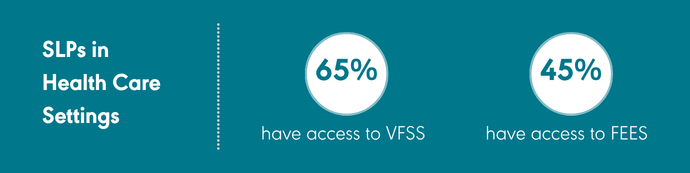
Source: 2024 ASHA Survey: Productivity, Staffing, and Resource Availability for SLPs. Email Surveys@asha.org for more information about this survey.
This resource provides practical strategies to show the impact of instrumental assessments in your facility to support safer, more effective, and more equitable dysphagia care.
Get to know your organization.
Before advocating for improved access to instrumental assessments, it is important to understand your organization’s priorities and goals. Every organization operates with financial, operational, and patient-centered targets. By connecting your request to these broader goals and showing how instrumental assessments contribute to quality improvement efforts, you position yourself as a strategic partner rather than a clinician asking for more resources.
Identify what leadership values the most right now.
Examples may include
- improving patient outcomes,
- reducing hospital re-admissions,
- meeting quality or safety metrics, or
- improving cost-effectiveness.
It’s also essential to consider whether decision makers understand the role of the speech-language pathologist (SLP) and the rationale for instrumental assessments. Many people may not be aware that clinical swallowing evaluations—although valuable—have limitations in assessing pharyngeal swallowing, evaluating upper esophageal functioning, and detecting silent aspiration.
Tips for getting to know your organization.
- Multiple people may be involved in ordering instrumental assessments: Identify all of those decision makers—beyond the SLP—including physicians or administrators. Take time to understand their perspectives, priorities, knowledge gaps, and any barriers they present in accessing instrumental assessments.
- Talk with colleagues in other departments (e.g., nursing, respiratory therapy) to understand their perspectives, priorities, and past successes with quality improvement initiatives.
- Review your organization’s mission and vision, departmental goals, strategic objectives, and consumer ratings (like Medicare Care Compare, Leapfrog, and Healthgrades).
Know how your organization stacks up.
Use to compare your facility’s access to instrumental assessments with that of other organizations in a similar setting.
Using the Dashboard
- Open the full-screen view by clicking the angled arrow icon in the bottom right corner
- Select a "Facility Category" to explore by setting. Note any differences between your setting and the benchmarks, and note any patterns that stand out.
- If you need additional or setting-specific data, email healthservices@asha.org.
Source: 2024 ASHA Survey: Productivity, Staffing, and Resource Availability for SLPs. Email Surveys@asha.org for more information about this survey.
Collect your data.
Gathering internal data from your facility strengthens your case for providing instrumental assessments. Using data helps demonstrate tangible impacts on patient care, safety, and efficiency.
Examples of metrics to track include
- delays in instrumental assessments and their impact on length of stay;
- patient outcomes—for example, comparing those who received instrumental assessments to those who did not and then looking at outcomes (e.g., improved oral intake, improved diet advancement, or reduced pneumonia rates); and
- re-admission rates that are tied to missed or misdiagnosed dysphagia.
Explore research data.
To learn more about the benefits of instrumental assessments, consult ASHA’s Evidence Maps:
Make the clinical case.
Use your clinical judgment and documentation skills to reinforce your recommendations for instrumental assessments.
Instrumental assessments support accurate dysphagia diagnosis and provide critical information that can reveal underlying medical conditions. They allow for targeted treatment planning—the SLP can tailor strategies, exercises, and patient education, all of which can improve patient outcomes.
Instrumental assessments are the only way to visualize laryngeal, pharyngeal, and upper esophageal anatomy and physiology—such visualization helps diagnose and treat dysphagia. VFSS and FEES can detect silent aspiration that would be missed during a clinical swallowing evaluation.
Resources
Put it all together.
You know your organization’s goals, you’ve collected your data, and you’ve built your clinical case—now it’s time to put it all together. This section guides you in translating your information into a clear message emphasizing the outcomes that your organization’s leadership cares about.
Start by summarizing—in one concise sentence—the access issues in your setting. This might include having limited equipment or team training, experiencing delays in completing instrumental assessments, or having patients being placed on overly restrictive diets while waiting for instrumental assessments.
Use your data to show why this matters to your organization. Explain how limited or delayed access to instrumental assessments affects patient safety, outcomes, satisfaction, and costs—highlighting risks such as re-admissions, longer lengths of stay, unnecessary interventions, and poor patient outcomes.
Then show what could improve with timely access. Explain how instrumental assessments support accurate diagnoses, individualized treatment plans, prevention of complications, and better patient outcomes while also advancing organizational priorities such as efficiency, quality, and cost reduction. Decision makers respond positively to strategies that improve outcomes, enhance patient safety, and reduce costs, so framing instrumental assessments in alignment with these goals makes your case more compelling.
For example, to make your request more persuasive, highlight how VFSS or FEES can
- prevent aspiration-related complications;
- shorten lengths of stay;
- reduce costs of unnecessary thickened liquids, feeding tubes, or restrictive diets; or
- increase patient satisfaction.
If leadership brings up cost as a barrier, then reframe your message:
- Emphasize goals of patient safety and prevention of adverse events.
- Highlight potential reductions in re-admissions and downstream expenses.
Resources
- Build a Case for Instrumental Swallowing Assessments in Long-Term Care
- FEES Program Justification Template [DOCX]
- Getting Started With Flexible Endoscopic Evaluation of Swallowing (FEES)
- Launching a FEES Program
- Speak the SNF Lingo to Show the Need for Instrumental Assessments
- The Case for Instrumental Assessments
Be strategic in your messaging.
Sometimes the biggest shift isn’t what you say—it's how you say it. Framing your message in terms of risk, outcomes, and solutions helps administrators hear and act on your recommendations.
Here are a few examples:
- Before:
- “I’m frustrated that we’re still relying on bedside evaluations.”
- After:
- “Clinical swallowing evaluations can’t detect silent aspiration. Instrumental assessments are appropriate for some patients and can give us the full picture of a patient’s swallowing ability. Using instrumental assessments supports better treatment planning and safer patient care. I’d like to explore ways to improve access to VFSS and FEES here.”
- Before:
- “No one seems to understand the importance of instrumental assessments.”
- After:
- “I’d like to meet with the care team to walk through when and why instrumental assessments are necessary and how they support outcomes that matter to patients and the facility.”
- Before:
- “I keep asking for FEES, but no one listens.”
- After:
- “Having FEES available in-house would allow us to assess patients sooner, avoiding the delays of off-site transport and reducing costs related to unnecessary diet restrictions or prolonged NPO status.”