Artificial Intelligence (AI): An Overview
Artificial intelligence (AI) is the umbrella term for technologies that let machines mimic human behaviors like learning, problem solving, and completing tasks that we used to think only humans could do. Under that umbrella, there are multiple types of algorithms, including:
- Machine learning (ML) is where computers “learn” patterns from data instead of relying on step-by-step programming. You’ll already see ML in some assessment tools and commercial platforms that adapt as they collect more data. Examples include streaming app recommendations, facial recognition, and targeted ads you might see on social media.
- Deep learning is a subset of ML, powered by layered neural networks; it’s the engine under the hood of most generative AI systems. Voice assistants, navigation apps, and tools that provide digital translation and transcription use deep learning.
Generative AI models use statistical patterning from massive reference datasets to generate text, images, audio, and many other new outputs. These outputs are not lookups—or a return of existing information—but new content based on the patterns and structure of their training datasets.
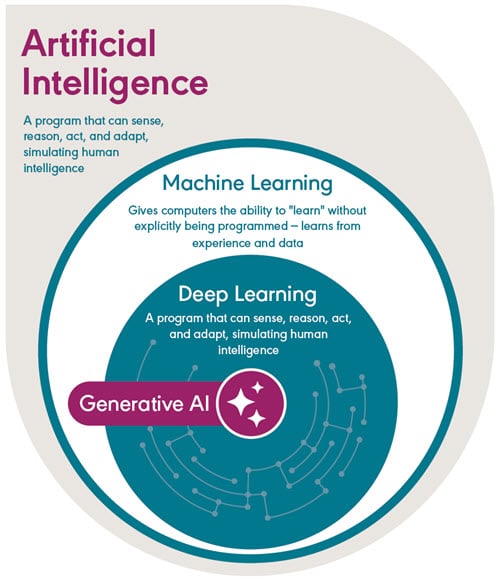
Source: Start Small, Dream Big: Getting Started With Generative AI (Reid, 2025).
A large language model (LLM) is a generative AI tool—specifically, a deep learning model—that uses massive amounts of text data to train the LLM to understand, generate, and manipulate human language.
The LLM can perform various tasks like these—and more:
- generating text
- translating text
- summarizing complex content
Many audiologists and SLPs who work in the United States are piloting and using generative AI large language models (LLMs) to support a variety of clerical and sometimes clinical tasks.
Generative AI tools are just that—tools. Generative AI cannot replace your clinical judgment or human connection.