ASHA Advocate: April 3, 2026
April 3, 2026

Live Webinar: Medicaid Advocacy in Action
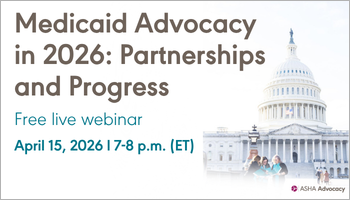
Medicaid policy changes can directly affect patients’ ability to receive services—and professionals’ ability to provide them. Join a free webinar on April 15 (7–8 p.m. ET) to learn how ASHA is addressing Medicaid changes and discover how advocates in Colorado, Idaho, Pennsylvania, and Wisconsin are responding to today’s real-world challenges. Attendees will walk away with insights into Medicaid trends, future policy impacts, and ways to get involved in their state.
Fighting Medicare Payment Cuts
Ongoing Medicare payment reductions continue to strain practices and limit patient access to care. ASHA’s advocacy efforts—alongside national partners—focus on eliminating policies like the Multiple Procedure Payment Reduction (MPPR). MPPR cuts reimbursement when multiple therapy services are provided on the same day. ASHA is also focused on delaying additional cuts that could further impact audiology and speech-language pathology services. These efforts aim to protect reimbursement and ensure patients can continue accessing the care they need. ASHA Advocacy sent joint letters to key House [PDF] and Senate [PDF] committees urging the repeal of MPPR.
On-Demand Information: Hearing Device Services Codes
Understanding new hearing device services codes is essential to ensuring accurate reimbursement and avoiding costly billing issues. This on-demand webinar—part two of a three-part series—walks audiologists through how to confidently apply the new codes in practice, navigate billing and compliance requirements, and strengthen their documentation to reduce the risk of denials.
New to the series? Start with Hearing Device Services Codes: 101.
From Practice to Policy: Professionals in Action
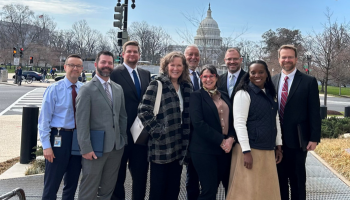
Members of ASHA’s Health Care Economics Committee took professionals’ concerns directly to lawmakers, advocating for fair Medicare payment, improved patient access, and fewer administrative barriers that delay care. By bringing real-world clinical and billing challenges to Capitol Hill, these members are helping shape decisions that impact reimbursement, workload, and the ability to serve patients. Ready to get involved? Write a letter today!
Advocating in the States
Across the country, ASHA Advocacy is addressing challenges that directly affect reimbursement, workload, and ability to deliver care—helping protect members’ practices and patients’ access to services. Recent efforts include:
- Idaho: Working with the Idaho state association to oppose a proposal [PDF] that would eliminate Medicaid coverage for audiology and speech-language pathology services, helping preserve access to essential care;
- Kansas: Supporting legislation [PDF] to establish licensure for speech-language pathology assistants, strengthening the workforce and helping expand patient access to services;
- Maryland: Opposing legislation [PDF] that could limit audiologists’ ability to meet Medicare quality reporting requirements under the Merit-based Incentive Payment System (MIPS);
- New Hampshire: Raising concerns about Medicaid rules [PDF] that could impose therapy caps, prior authorization barriers, and unclear provider standards—issues that can delay care and increase administrative burden; and
- Washington: Advocacy win! In collaboration with the Washington Speech-Language-Hearing Association, helped pass legislation (S. 6226) [PDF] to protect audiologists’ and SLPs’ ability to use clinical judgment when providing services via telehealth—reducing administrative barriers and improving patient access to care.
ASHA-PAC Launches Spring Fundraising Campaign
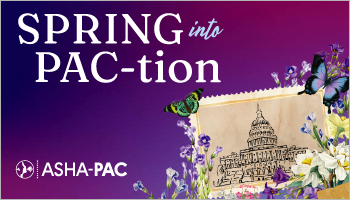
ASHA’s political action committee (ASHA-PAC) has launched its annual spring fundraising campaign, Spring into PAC-tion, giving members another way to advocate for the professions while celebrating the PAC’s 40th anniversary. ASHA members who donate $20 can win a bouquet of flowers sent to an address of their choosing, while those who contribute $100 or more get a chance to win a bouquet every month for a year. Donate before April 30 to be eligible to win one of these great gifts! Visit ASHA-PAC to learn more about drawing rules and how contributions to ASHA-PAC are an investment in your professional future.
Working for You
- Reducing administrative burden by calling on HHS and CMS [PDF] to scale back requirements related to fraud, waste, and abuse that can delay care or interfere with clinical decision-making.
- Protecting Medicaid access by opposing federal actions [PDF] that could restrict home and community-based services, helping ensure patients can continue receiving care in their communities.
- Improving coverage and access by engaging policymakers [PDF] to strengthen provider networks and oppose therapy caps in the ACA marketplace.
- Supporting affordability by backing legislation to improve access to hearing aids for veterans [PDF] and reduce out-of-pocket costs for patients through tax credits [PDF].
- Investing in your career by advocating for policies that would allow 529 plans to cover continuing education, licensure, and certification costs.
- Informing future policy by supporting a national study on special education spending [PDF] to ensure audiology and speech-language pathology services are accurately represented in funding decisions
- Bringing members’ perspective to policy discussions by representing members working in skilled nursing facilities during a therapy panel at ADVION’s Legislative & Regulatory Conference focusing on reimbursement, access, and the future of the professions
Find more comments and testimony letters on ASHA's website.
Spotlight: Progress on Medicaid Rates and Patient Access
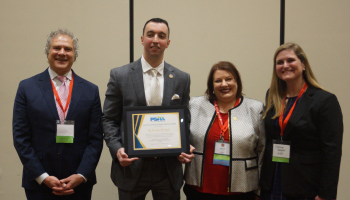
ASHA Advocacy joined ASHA’s President-Elect, Perry Flynn, at the Pennsylvania Speech-Language-Hearing Association’s (PSHA) annual convention last week, where sessions focused on key advocacy priorities impacting audiologists and SLPs. Flynn shared updates on national advocacy efforts, while PSHA President Nicole Billak and ASHA Advocacy staff member Caroline Bergner highlighted progress to improve Medicaid reimbursement rates for speech therapy in Pennsylvania—where payment for CPT code 92507 is around $20—and ongoing work with legislators to advance sustainable solutions.
PSHA also recognized Pennsylvania State Representative Brandon Markosek—who has spoken about his lifelong experience with a stutter and helped advance coverage for stuttering therapy—for his legislative advocacy.
(Left to right: Perry Flynn, Rep. Brandon Markosek, Nicole Billak, Caroline Bergner)
Resource Highlight
Medicare and Medicaid are both government-funded health insurance programs, but they are very different in who they serve, how they're funded, and who oversees and administers them. Explore ASHA's Medicare vs Medicaid Guidebook to better work and advocate for change within them. Use this virtual or printable resource as a guide or refresher, share it with a coworker or employee enrolling in either program, or to help prepare CSD students for the work force!