Advocacy Recap: 2025 Review and 2026 Outlook
January 29, 2026
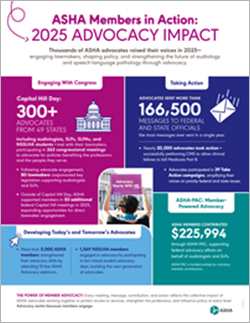
About a month into 2026, ASHA continues advocating to advance policies that benefit audiologists, speech-language pathologists (SLPs), and the people they serve. In 2025, this work spanned federal and state advocacy in a volatile and uncertain policy and political environment. Last year brought a high volume of executive actions, legislative activity, regulatory proposals, and important implementation decisions across health care, education, public health, and workforce policy. With that came a record-breaking year of ASHA and NSSLHA advocate engagement [PDF].
While many federal actions drew national attention, much of the real-world impact of policy occurred through sustained advocacy with Congress, federal agencies, and—critically—state-level engagement, where implementation, funding, and service delivery decisions are often made.
Many 2025 policy actions are now moving to the implementation stage. That makes continued advocacy, oversight, and coordination across federal and state levels especially important as guidance is interpreted, enforced, and funded. This includes preparation for implementation of major federal legislation enacted in 2025, such as the One Big Beautiful Bill Act (H.R. 1). ASHA Advocacy expects we’ll see major impacts from this and other legislation in 2026.
On this page:
- In Case You Missed It: 2025 Policy and Advocacy Highlights
- Major Legislation on the Horizon: Preparing for 2026 Implementation
- Education Policy: Governance Shifts, School Choice, and Compliance Expectations
- Access to Health Care Services: Telehealth and Coverage
- Workforce, Licensure, and Service Delivery
- Artificial Intelligence and Technology: Accelerated Adoption and Oversight
- Recognizing Advocates Who Stepped Up in 2025
- What to Watch in 2026
- Questions?
In Case You Missed It: 2025 Policy and Advocacy Highlights
Key federal executive actions and policy directives ASHA monitored and engaged on in 2025 included:
- Education governance and local control initiatives, including actions encouraging greater state and community authority over education policy and federal functions.
- School choice and education funding flexibility efforts, including direction to explore expanded use of federal funds for alternative K–12 education options.
- Executive actions affecting DEI-related programs and requirements, with potential implications for education and federally funded programs.
- Federal policy actions related to gender-affirming care, including agency-level implementation steps and litigation affecting enforcement.
- Federal workforce and regulatory “pause” directives, including measures affecting hiring, agency communications, and rulemaking.
- Health care pricing transparency initiatives intended to strengthen access to clear and actionable health care price information.
Throughout the year, ASHA paired policy monitoring with direct advocacy—engaging lawmakers, agencies, state associations, and advocates nationwide to shape outcomes across these areas.
Major Legislation on the Horizon: Preparing for 2026 Implementation
In addition to executive actions and agency policy, 2025 saw enactment of significant federal legislation with wide-ranging implications for health care, education, and the workforce. Among these was the One Big Beautiful Bill Act (H.R. 1), a comprehensive legislative package that will jeopardize or harm federal funding, programs, and implementation requirements across multiple policy areas.
While many provisions of H.R. 1 will be implemented in 2026, ASHA engaged throughout 2025 to assess potential impacts on audiologists, SLPs, and the people they serve. This included monitoring statutory language, engaging congressional offices, and preparing resources to support advocates as agencies translate legislative direction into regulations and guidance.
For example, ASHA communicated with members and students about proposed federal student loan limits tied to the definition of “professional degree” programs—changes that may exclude audiology and speech-language pathology programs and increase financial barriers for students entering the professions. ASHA was also engaged in sustained advocacy to oppose harmful Medicaid funding cuts and protect access to care for audiology and speech-language pathology services.
ASHA will continue working with federal and state policymakers in 2026 to ensure that implementation decisions reflect the needs of the professions, protect access to services, and avoid unintended consequences for providers, clients, patients, and students.
Education Policy: Governance Shifts, School Choice, and Compliance Expectations
Several 2025 executive actions and legislative proposals focused on shifting authority over education policy and funding from the federal government to state and local entities while expanding education choice initiatives. These developments may influence federal education oversight, funding flows, and civil rights compliance expectations in school settings.
Why it matters: School-based audiologists and SLPs rely on stable systems that support service delivery, staffing, and consistent protections for students receiving special education and related services. ASHA monitored federal education actions closely for implications affecting access to services, protections for students with disabilities, and consistency of implementation across states and districts.
In parallel, ASHA raised these issues directly with federal lawmakers and agency officials through congressional meetings and advocacy campaigns. ASHA also supported state-level advocacy addressing school-based service delivery, workload concerns, licensure requirements, and protections for students with disabilities.
Access to Health Care Services: Telehealth and Coverage
Telehealth access and payment policy remained a central advocacy focus in 2025. Congress extended Medicare telehealth authority for audiologists and SLPs through September 30, 2025, and again through January 30, 2026—preserving an important access pathway for beneficiaries. At the same time, the Centers for Medicaid & Medicare Services (CMS) coverage of audiology and speech-language pathology services provided through telehealth will also expire without further congressional action.
NOTE: Congress is currently considering a federal funding package that includes an extension of Medicare telehealth authority through December 31, 2027. ASHA is closely monitoring these negotiations and will provide updates as soon as new legislative action is finalized.
Why it matters: Telehealth expands access to audiology and speech-language pathology services, particularly for rural and underserved communities.
These extensions followed sustained advocacy by ASHA advocates, including Capitol Hill meetings, Take Action campaigns, and direct engagement with lawmakers and CMS. ASHA also supported state advocacy related to Medicaid coverage and reimbursement rates, licensure flexibility, telepractice policies, and state-level barriers that affect access to care.
ASHA continues advocating for federal and state policy solutions that protect and expand access to services.
Workforce, Licensure, and Service Delivery
Workforce challenges—including recruitment, retention, supervision, and working conditions—remained a cross-cutting advocacy priority in 2025.
At the federal level, ASHA engaged on issues affecting training, supervision, and emerging workforce pressures. One of ASHA’s major advocacy efforts helped prompt CMS to revise its interpretation of a qualified SLP so that services delivered by SLPs during their clinical fellowship can be billed to Medicare Part B.
At the state level, ASHA supported advocacy addressing licensure and scope of practice, supervised professional experience requirements, interstate practice, school-based workload and caseload policies, and other service delivery issues that directly affect clinicians’ ability to provide care.
Together, these efforts reinforced ASHA’s goal of strengthening and sustaining the audiology and speech-language pathology workforce across settings.
Artificial Intelligence and Technology: Accelerated Adoption and Oversight
AI policy emerged as a major theme in 2025. Executive actions and federal guidance encouraged accelerated adoption while emphasizing governance, transparency, and oversight.
Why it matters: AI-driven tools are increasingly used in clinical and educational environments, including documentation support, screening, assistive technology, and learning platforms. They are also used by payers to automate claims processing, assess risk, detect fraud, and support coverage and utilization management decisions. Federal and state policy decisions influence which technologies are deployed and what standards apply related to accuracy, bias, and privacy.
ASHA monitored these developments and engaged policymakers and stakeholders to ensure that evolving technology policies reflect the interests of practitioners and the people they serve.
Recognizing Advocates Who Stepped Up in 2025
Every advocacy milestone in 2025 was driven by ASHA members and NSSLHA students who chose to engage. They met with lawmakers, took action on priority issues, participated in advocacy days, and built advocacy skills to support the professions.
Advocates at every career stage raised their voices on issues affecting audiologists, SLPs, and the people they serve. Their collective engagement strengthened ASHA’s advocacy efforts and positioned the association to respond to emerging challenges and prepare for policy implementation in 2026.
Learn more about the impact of advocate engagement in ASHA Members in Action: 2025 Advocacy Impact, a one-page summary highlighting how advocates across the country helped shape policy outcomes in 2025.
Moving forward, continued advocate engagement will be essential as major policy changes move into implementation in 2026. Every meeting, message, and action reflects the collective impact of ASHA advocates working together to protect access to services, strengthen the professions, and influence policy at every level.
What to Watch in 2026
As implementation continues, ASHA is monitoring and engaging on developments in the following areas:
- Medicare telehealth authority: timelines, extensions, and prospects for permanence
- Medicaid funding and access: federal and state policy proposals affecting program financing, eligibility, benefits, and access to audiology and speech-language pathology services
- Student loan limits: implementation of the federal definition of “professional degree” and related borrowing limits and their potential impact on students pursuing audiology and speech-language pathology programs
- Education governance and funding policy: implications for special education services and protections
- Workforce policy: licensure, supervision, working conditions, and workforce supports—including salary supplements for school-based providers
- Federal and state AI policy: emerging standards affecting clinical and educational environments
- Agency guidance and enforcement at both the federal and state levels: particularly those that affect access, coverage, and compliance requirements.
ASHA will continue working with lawmakers, federal and state agencies, state associations, stakeholders, and advocates to shape positive outcomes across these areas.
For ongoing updates, visit ASHA’s Advocacy News and Take Action pages.
Questions?
For questions about state and federal health care and education policies, contact the health care education and policy team at reimbursement@asha.org.
For questions about federal-level congressional advocacy, contact the federal affairs team at federal@asha.org.
For questions about state-level advocacy, contact the state affairs team at states@asha.org.