A Small but Mighty Advocacy Victory in Wisconsin
February 19, 2026
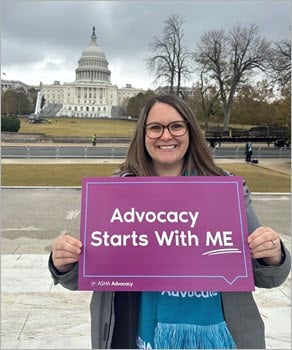
It was October of 2024 when Dr. Brittney Gniedziejko, an audiologist and ASHA member in Wisconsin, first encountered the problem.
With no warning, Wisconsin Medicaid began to require a prescription for hearing aids signed by a physician—in addition to the medical clearance appointment that is required for patients under the age of 18.
Since prescription pads are not readily available anymore, Dr. Gniedziejko—who works at the Masters Family Speech and Hearing Center at Children's Wisconsin—and her team had to get creative to develop a new “prescription for hearing aids.”
Because this is not an administrative requirement from other payers in the state, she had to create a simple Word document that listed the make and model of the device being ordered, the proper diagnosis code, and a line for a physician signature.
If the provider was in their hospital system, they would send this prescription request digitally in their electronic medical record. The electronic prescription would then need to be saved as a PDF to submit along with clinical documentation for prior authorization review.
Dr. Gniedziejko said this was a major administrative burden on her team—and a problem for her patients.
“The audiologist writes the information about what hearing aid is recommended and why in the patient’s medical record, so having to include this information on a prescription so a physician can sign is duplicative work,” she said. “It’s in the scope of practice of an audiologist to dispense a hearing aid without a prescription signed by a physician. If there was a delay in getting the prescription signed, we were not able to submit the PA to insurance, which delayed care.”
Dr. Gniedziejko reached out to ASHA and her state association to start tackling the problem. She worked with other members of the Wisconsin Speech-Language Pathology and Audiology Association (WSHA) and became a leader of its Medicaid committee. Dr. Gniedziejko is also a member of ASHA’s Medicaid Committee and regularly meets with ASHA staff dedicated to Medicaid advocacy and other ASHA member Medicaid providers as part of that group.
Dr. Gniedziejko researched other state licensure laws and Medicaid guidelines, especially those of her neighbors (since Medicaid agency policies often mimic those of their neighbors), and created a spreadsheet of their requirements for hearing aid dispensing. (Note: Medicaid requirements, funding, and other elements differ from state to state, as Medicaid is a state-controlled program. To learn more about how Medicaid works—and how it relates to Medicare—check out ASHA’s Medicare vs Medicaid resource.)
Dr. Gniedziejko brought up these different laws and requirements at Wisconsin Medicaid’s quarterly therapy meetings, but no one addressed her questions. Working with Caroline Bergner, ASHA’s director of health care policy for Medicaid and the staff ex officio to ASHA’s Medicaid committee, Dr. Gniedziejko and ASHA staff reached out to Wisconsin Medicaid to clarify the history of the policy change and see whether the requirement for a prescription could be removed. ASHA Advocacy contacted roughly 50 staff at Wisconsin Medicaid to figure out why this requirement had suddenly appeared. Meanwhile, ASHA Advocacy advised Dr. Gniedziejko to reach out to Medicaid field representatives and consult with a lobbyist.
Dr. Gniedziejko and ASHA staff scheduled a meeting with a state lobbyist, who then had a conversation with the Wisconsin Department of Health Services to clarify this requirement and determine if Dr. Gniedziejko needed to submit an update to Medicaid or write a bill in order to remove the requirement. In the meantime, Dr. Gniedziejko also submitted it as an agenda item for the quarterly therapy association meeting.
The day of that meeting, December 2, 2025, Dr. Gniedziejko received an update from Medicaid: a physician no longer needed to sign the prescription, and any provider practicing within their scope (including audiologists) could sign it. This change aligned Wisconsin’s requirements with other states’ requirements.
A Small but Mighty Win
This advocacy victory is small but powerful. Removing burdensome paperwork makes providers’ jobs easier and ensures their patients receive the care they need when they need it.
If you’re an audiologist or SLP who’s interested in tackling problems like this in your own state, Dr. Gniedziejko recommends starting with a local focus.
“I would start by talking to your state association or other audiologist groups in the state to ask what their priorities are,” she said. “There may already be a task force or committee working on the items you are wanting to change. I would also do research and look at nearby states or talk to other providers in the state to see if their policy is similar or different to what you are experiencing. ASHA is always here to help as well.”
Lastly, Dr. Gniedziejko recommends asking other associations for help. “Email ASHA, AAA, ADA and see what their priorities are, take their surveys to help create priorities, and ‘be the squeaky wheel.’”