Multi-Tiered System of Supports (MTSS)
The term multi-tiered systems of support (MTSS) describes a broad educational framework that provides students with increasingly intensive levels of support to meet their academic and non-academic (behavioral, social and emotional) strengths and areas of need.
This system-wide framework focuses on improving core (Tier 1) instruction to prevent learning and behavioral difficulties before they arise. Students who may benefit from targeted or individualized support have access to Tier 2 and Tier 3 interventions that rely on continuous collaboration within the school system. Data-driven decision making and evidence-based practice ensure all students’ progress.
Response to intervention (RTI) is one element of a multi-tiered system of support (MTSS) for providing services to targeted learners at increasing levels of intensity. RTI is related to, but distinct from, MTSS. RTI focuses on identifying disabilities in a valid manner by tracking how students respond to interventions, whereas MTSS is system-wide framework focused on proactively supporting student needs.
On this page:
- Features of the Tiers
- Why SLPs Should be Involved in MTSS
- Key Benefits of MTSS
- MTSS: What's True and False?
- What Research Says About MTSS
- MTSS in States
- What Federal Policies Say About MTSS
- Funding for MTSS Implementation
- Implementing MTSS: Key Considerations for SLPs
- Case Studies
Features of the Tiers
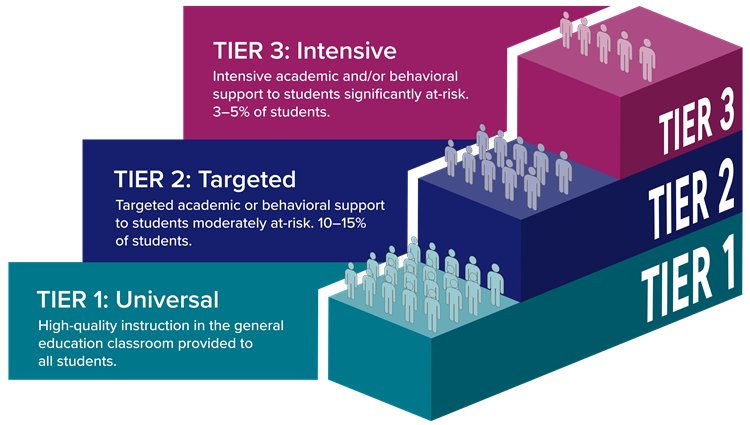
This figure represents a classroom of approximately 20 students.
Tier 1 - Universal Support
- Tier 1 is proactive and preventative.
- It includes research-based core instruction and supports aligning with grade-level standards for all students.
- Teachers use differentiated instruction for all students to access the curriculum.
- Most students benefit from Tier 1 programming alone.
Tier 2 - Targeted Interventions
- Tier 2 programming is delivered wiht greater intensity than Tier 1 programming.
- It consists of targeted small-group interventions for students who need additional support beyond Tier 1.
- In Tier 2 programming, specific teams select or design evidence-based interventions and supports that meet student needs and help achieve desired outcomes.
- Interventions at this tier allow increased opportunities for practice and corrective feedback.
Tier 3 - Intensive Interventions
- Interventions at the Tier 3 level are increasingly more intense than those at the Tier 2 level.
- Tier 3 interventions involve individually tailored/targeted support.
- Tier 3 is designed specifically for students with significant and persistent academic, social, emotional, or behavioral needs—including diagnosed disabilities.
- Instruction and support at the Tier 3 level is individualized and data driven.
Why SLPs Should be Involved in MTSS
Speech-language pathologists (SLPs) bring specialized expertise in language, literacy and evidence-based assessment that directly informs effective tiered instruction and intervention within MTSS. When SLPs are involved in MTSS, it allows them to:
- Collaborate with educators and related professionals (e.g. classroom teachers, special education teachers, school psychologists, counselors, curriculum coaches, school administrators)
- Improve the quality of instructional practices—with the aim of preventing students from requiring more specialized services.
- Proactively support students
- Include students who need support but may not qualify for an individualized education program (IEP).
- Meet students’ needs without relying solely on special education services.
- Meet the needs of students with disabilities
- Integrate speech-language services into the general education curriculum.
- Provide relevant data to inform decision making
- Accurately identify students with disabilities.
- Inform and support appropriate eligibility decisions.
Key Benefits of MTSS
When implemented with fidelity, MTSS can enhance the SLP’s role and student outcomes as:
- The framework enhances opportunities for interprofessional practice and collaboration.
- Students may experience improved generalization and dissemination of strategies.
- This approach builds a stronger sense of community and purpose within the school.
- The negative effects associated with labeling students is potentially reduced when students' needs are met outside of special education.
- Staff are better able to meet student needs without special education paperwork, potentially reducing workload.
See how students' communication and literacy skills improve with support from the school-based SLP in The Value of the Speech-Language Pathologist (SLP) in Schools: Prevention and Response to Intervention.
MTSS: What's True and False?
Use these true/false statements to build and assess your understanding of key concepts related to MTSS and SLP practice.
What Research Says About MTSS
Learn more about MTSS research in different target areas, physical locations, and target population. Conclusions of each research article are listed.
MTSS in States
This interactive map provides links to state-specific MTSS guidance. Select a state to access available guidance or filter by region (Northeast, South, Midwest or West).
What Federal Policies Say About MTSS
Two laws—the Every Student Succeeds Act (ESSA) and the Individuals with Disabilities Education Act (IDEA) — address MTSS. Learn about
- what these federal policies say about MTSS and
- the implications of these policies on SLPs and their work.
Every Student Succeeds Act (ESSA)
ESSA is a federal policy governing general education.
Key Areas Related to MTSS
- Defines MTSS as “a comprehensive continuum of evidence-based, systematic practices to support a rapid response to students’ needs, with regular observation to facilitate data-based instructional decision making” [Sec. 8002 [20 U.S.C. 780]; (33)].
- Supports “the provision of services to students who are not currently identified as needing special education but who need additional academic and behavioral support to succeed in a general education environment” [Sec. 2103 [20 U.S.C. 6312]; (b)(3)(F)].
Implications for SLPs
- ESSA supports the MTSS framework as a data-driven, flexible way of quickly addressing student needs that can be met without an individualized education program (IEP).
- In funding sources, flexibility exists when it comes to supporting students who are considered “at risk.” This funding can go toward supporting SLPs’ involvement in MTSS frameworks.
- It is justifiable for SLPs to provide services outside of special education through an MTSS framework (Sylvan, 2026).
- SLPs can consult ASHA’s resource, Every Student Succeeds Act: Key Issues for ASHA Members [PDF] — a comprehensive summary and analysis of key topics important to SLPs.
Individuals With Disabilities Education Act (IDEA)
IDEA is a federal policy governing special education.
Key Areas Related to MTSS
- Students without disabilities may also benefit from SLPs in the classroom as an “incidental benefit” [IDEA 2004, 34 C.F.R 300 (208) (a)].
- A local education agency (LEA), under IDEA Part B, may use funds for “services and aids that also benefit non-disabled children” [IDEA 2004, 34 C.F.R. 1413 (a)].
- IDEA allows LEAs to allocate up to 15% of their IDEA Part B funds “for students . . . who are not currently identified as needing special education or related services, but who need additional academic and behavioral support to succeed in a general education environment” [IDEA 2004, 34 C.F.R. 300 (226)].
- IDEA allows data regarding how students respond to research-based intervention to be used in the eligibility determination process [IDEA 2004, 34 C.F.R. 300.309 (a)(2)(i)].
Funding for MTSS Implementation
MTSS frameworks are funded by multiple sources—including
- IDEA Part B,
- Elementary and Secondary Education Act (ESEA) Title I-=III funds, and
- state and technical assistance grants.
Read more about MTSS-related funding in MTSS: Understanding Professional Roles and Funding Mechanisms for Obtaining Grants and Local Money [PDF]
Implementing MTSS: Key Considerations for SLPs
Successful implementation of a multi-tiered system of support (MTSS) framework is a dynamic opportunity for speech-language pathologists (SLPs) to leverage their specialized expertise and to recognize the following realities about MTSS.
Note: These statements are not listed in order of importance.
- The MTSS framework is not prescriptive—there is no single “right way,” to apply it. MTSS can take many forms.
- MTSS is not “all-or-nothing”—SLPs can incorporate it in ways that are meaningful for their setting and workload.
- MTSS requires SLPs to be visible and impactful within schools.
- MTSS requires ongoing collaboration among SLPs, teachers, and school administration.
- SLPs can advocate for their role by communicating their expertise and demonstrating how they contribute to student outcomes.
- The MTSS framework is a valid and defensible approach to collecting eligibility data.
- SLPs can use data collection tools to track student response to short-term intervention.
- MTSS can reduce over-reliance on standardized assessments, supporting more equitable and holistic evaluation of student needs.
- It is important to set MTSS goals that are both realistic and ambitious.
- Existing research, resources, and online communities of SLP practitioners are available to support implementation.
In each case study below, we present the current context and challenges followed by the lettered reality or realities that the SLP in the case study considers in order to make meaningful changes in practice moving forward (e.g., Reality A, Reality J).
Case Studies
Here, we present two case studies that reveal how SLPs facing unique contexts and challenges in a school district moved forward with implementing change and taking the first step with MTSS in their work with students and school systems based on realities described above.
Case Study #1 — Ryan
Ryan is a school-based SLP at multiple schools within a district.
Context and Challenges
- Ryan uses small-group, pull-out sessions as his main mode of service delivery.
- Ryan wants to implement MTSS but is concerned about the time required — and the impact on his workload.
Realities Applicable to This Case Study
Ryan reflected on several realities from the lettered list above to forge a new MTSS path forward.
Reality A: The MTSS framework is not prescriptive.
- Ryan recognizes that collaboration with teachers is core to MTSS.
- Ryan does this in a way that fits his schedule and situation.
- Ryan provides presentations on professional development days.
Reality C: MTSS requires SLPs to be visible and impactful in schools.
- Ryan wants his co-workers to understand his role, but he doesn’t have time to meet with all of them.
- Ryan plans to meet with each principal and participate in professional learning community meetings.
Reality F: The MTSS framework is a valid and defensible approach to collecting eligibility data.
- Ryan is experiencing an increase in referrals.
- Based on the nature of the referrals, he believes that most of these students will be best served by short-term intervention rather than full-scale evaluation.
Reality I: It is important to set MTSS goals that are both realistic and ambitious.
- Ryan is very enthusiastic about MTSS.
- He plans to start small and ramp up over time.
- Ryan coordinates with teachers to collaborate on future lessons.
Reality J: Existing research, resources, and online communities of SLP practitioners are available to support implementation.
- Recognizing that it is important to identify and share resources, Ryan follows his plan to move forward with MTSS — and turns to trusted resources.
- Ryan reads vetted, evidence-based articles and books
- He seeks reliable data collection tools that well-regarded programs have successfully used.
Case Study #2: Shelby
Shelby is a school-based SLP who works with students in preschool through second grade.
Context and Challenges
- Shelby delivers services to students individually or in small groups.
- She collaborates with and supports teachers.
- She wants to get more involved in MTSS but doesn’t want to work within the classroom.
Realities Applicable to This Case Study
Shelby reflected on several realities from the lettered list above to forge a new MTSS path forward.
Reality A: The MTSS framework is not prescriptive.
- Shelby realizes that MTSS does not require her to work in the classroom.
- Shelby is excited about continuing to foster relationships with teachers and to help students who are “falling through the cracks.”
Reality C: MTSS requires SLPs to be visible and impactful in schools.
- Shelby plans to meet with the administration to see how she and they can work together to support students.
- She specifically wants to discuss how her expertise can help to
- support the administration’s new literacy interventions and
- build meaningful bonds and relationships with all staff members.
Reality F: The MTSS framework is a valid and defensible approach to collecting eligibility data.
- Shelby is experiencing an increase in referrals.
- She plans to provide short-term interventions and collect data on students’ responses.
Reality I: It is important to set MTSS goals that are both realistic and ambitious.
- Shelby knows she can’t do everything, so she sets these goals for the year:
- Get involved with literacy interventions.
- Collect data on short-term interventions.
Reality J: Existing research, resources, and online communities of SLP practitioners are available to support implementation.
- Even though Shelby is excited about MTSS, she has some questions that remain unanswered.
- She knows that it’s important to identify and share resources, so she makes plans to
- read research studies and
- find data collection resources related to literacy.