Multi-Tiered System of Supports (MTSS) and Response to Intervention (RTI)
What is a Multi-Tiered System of Supports?
The term multi-tiered system of supports (MTSS), describes an educational framework that provides students with increasingly intensive levels of support to meet their academic and non-academic (behavioral, social and emotional) needs.
What is Response to Intervention?
The response to intervention (RTI) process is a type of Multi-Tiered System of Support (MTSS) for providing services and interventions to struggling learners at increasing levels of intensity.
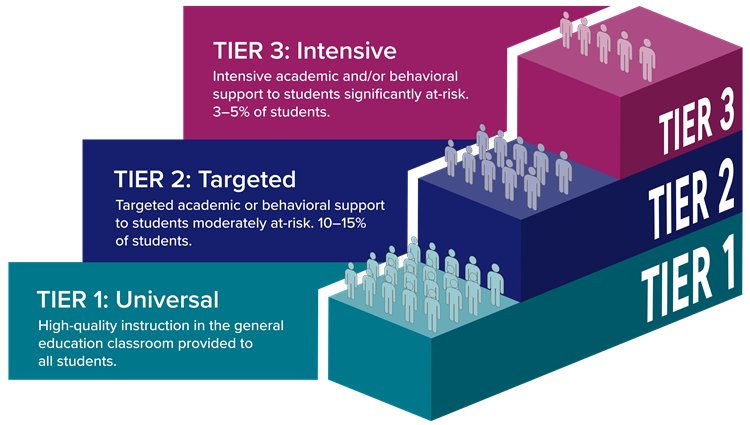
Features of the Tiers
Tier 1 - Universal Support
- Includes research-based core instruction and supports in line with grade-level standards for all students
- Teachers use differentiated instruction for all students to access the curriculum
- Most students benefit from Tier 1 programming alone.
Tier 2 - Targeted Interventions
- Targeted small group interventions for students who need additional support.
- Specific teams select or design evidence-based interventions and supports for student needs and desired outcomes
- Interventions at this tier allow increased opportunities for practice and corrective feedback
Tier 3 - Intensive Interventions
- Interventions are increasingly more intense than in Tier 2.
- For students with significant and persistent academic, social, emotional or behavioral needs, including diagnosed disabilities.
- Instruction and supports are individualized and data driven
See this chart on SLP roles in MTSS and referral [PDF].
Roles for SLPs
Speech-language pathologists (SLPs) can play number of important roles in MTSS and RTI. These roles include:
- collaborating with other educators to improve instructional practices related to language and literacy
- assisting with selection of screening measures
- assisting with selection of scientifically based literacy interventions
- aiding general education teachers with universal screening
- conducting expanded speech sound error screenings for K–3 students, enabling teachers and staff to (a) track students at risk and (b) intervene with those students who may respond to short-term interventions
- interpreting screening and progress assessment results for families
- consulting with teachers to meet the needs of students in initial MTSS tiers with a specific focus on the language underpinnings of learning and literacy providing professional development to educators, thus supporting classroom instruction
- partnering with teachers to deliver whole-class lessons or to collaboratively teach lessons.
Benefits of MTSS
MTSS has a number of benefits for students and speech-language pathologists. Implementing MTSS can significantly reduce SLPs’ caseloads by addressing students’ educational needs more effectively (Marante & Farquharson, 2021).
Key benefits of MTSS for SLPs include
- enhanced opportunities for collaboration,
- improved generalization and dissemination of strategies,
- a stronger sense of community and purpose within the school,
- reduced labeling of students with speech-language impairments, and
- more efficient meeting of student needs without the need for special education paperwork.
Studies show that following implementation of MTSS:
- the number of students with individualized education programs (IEPs) for mild articulation errors decreased from 821 to 95 across a span of 4 years (Taps, 2008),
- 98% of students with one to two speech sound errors corrected these errors within 9 months under an RTI framework (Mire & Montgomery, 2009), and
- even when an IEP was required after a child received services within an MTSS framework, the length of time in therapy was less (Bruce, et.al., 2018)
MTSS offers a comprehensive approach that not only alleviates the workload of SLPs but also enhances students’ overall educational experience.
See how students' communication and literacy skills improve with support from the school-based SLP in The Value of the Speech-Language Pathologist (SLP) in Schools: Prevention and Response to Intervention.
Response to Intervention in IDEA '04
Learn what IDEA says and the implications for ASHA members.
- IDEA: Specific Learning Disabilities — defines what IDEA says about specific learning disability, discusses the implications for ASHA members, and suggests specific actions that ASHA members can take.
- IDEA: Early Intervening Services — includes what IDEA says regarding early intervening services and discusses the implications for ASHA members.
- Every Student Succeeds Act: Key Issues for ASHA Members [PDF] — summarizes the Every Student Succeeds Act and presents an analysis on key topic areas that ASHA members should pay close attention to.
- OSEP Letter: January 29, 2019, letter to Dr. Zirkel — this letter addresses a series of questions regarding the implementation of RTI and MTSS in relation to IDEA 2004.
Tools for Implementation
RTI in Action: Oral Language Activities for K–2 Classrooms
A practical response to intervention (RTI) activity book with a focus on oral language.
RTI in Action: Grades 3–5: Oral and Written Language Activities for the Common Core State Standards (CCSS) This activity book focuses on oral language activities for students in grades 3-5.
MTSS Entrance-Exit Criteria [PDF] (Oakland Schools, Michigan)
Speech/Language Consultation Meeting Template [PDF] (San Diego Unified School District, California)
Individualized Language Interventions Student Action Plan and Data Collection Template [PDF] (San Diego Unified School District, California)
Funding and Advocacy
MTSS: Understanding Professional Roles and Funding Mechanisms for Obtaining Grants and Local Money [PDF]
ASHAWire
Special Collection: Multi-Tiered System of Support
The articles in this collection focus on MTSS implementation, presenting research on the effectiveness of interventions delivered in the classroom and via telepractice. A number of articles focus on the SLP’s role as part of the MTSS team, highlighting the importance of collaboration. Finally, the remaining articles focus on intervention, sharing evidence-based approaches when working with students.
Explore additional collections for school-based practice: Special Collections Provide Resources for School-Based SLPs - ASHA Journals Academy
References
Marante, L., & Farquharson, K. (2021). Tackling burnout in the school setting: Practical tips for school-based speech-language pathologists. Perspectives of the ASHA Special Interest Groups, 6(3), 665–675. https://pubs.asha.org/doi/abs/10.1044/2021_PERSP-20-00262
Mire, S. P., & Montgomery, J. K. (2009). Early intervening for students with speech sound disorders: Lessons from a school district. Communication Disorders Quarterly, 30(3), 155–166. https://doi.org/10.1177/1525740108326593
Taps, J. (2008). RTI services for children with mild articulation needs: Four years of data. Perspectives on School-Based Issues, 9(3), 104–110. https://doi.org/10.1044/sbi9.3.104
Related Resources
Center on Multi-Tiered System of Supports
This center supports states, districts, and schools across the country in implementing an MTSS framework to maximize student achievement and support student success.
IRIS Center located at Vanderbilt’s Peabody School, provides modules with activities, case studies and resources on RTI implementation.
- RTI Part 1: An Overview
- RTI Part 2: Assessment
- RTI Part 3: Reading Instruction
- RTI Part 4: Putting It All Together
- RTI Part 5: A Closer Look at Tier 3
Essential Components of MTSS
Developed by the MTSS Center, this page defines MTSS and outlines the main components of the systems.
International Literacy Association (ILA) [PDF]
This brochure outlines six key principles to guide thinking and professional work in the area of RTI.
Is MTSS the New RTI? Depends on Where You Live
This article and map from the MTSS Center, highlights the terminology (RTI or MTSS) used across states.